
I’ve just sat upright in my bed. My heart is racing. I’m jittery and twitchy. The ba-dump in the night is not me dreaming that zombies are invading my home. It’s my heart doing the conga, to the tune of Day O, as played in the movie Beetlejuice! It’s because I dared to eat dessert past 5 o’clock.
My ability to metabolize sugar has shifted as I’ve aged, which the medical community says is common. The upside is that this has given me an overdue incentive to take control of my sugar addiction that has tempted me since I was young.
A documentary I stumbled upon in our student commons while attending Western Washington University in 1984 has haunted me for decades. A nutritionist poured a mound of sugar into a bowl to demonstrate how much is in a serving of cereal. That image has stuck with me like Linda Blair’s projectile barf in the 1973 movie, The Exorcist. Sadly, no matter how shocking, the image failed to change my consumption when I was in my early 20s. I kept consuming peanut m&m’s till my fingers hit the bottom of the bag. In my defense, they tasted different back then. Less sweet. I could actually taste peanuts, which was a source of protein that counteracted the sugar. That’s what I’d told myself for years. Convincingly, I might add. Now, either my tastebuds have become more sensitive to sweeteners, or the Mars company is sweetening the peanuts or thickening the sugary coating. I wish I could test my theory, but I couldn’t find nutritional information from a 1980s wrapper to compare with a wrapper from today. A mite suspicious if you ask me.
According to what I’ve read and seen in documentaries, manufacturers are adding more sweeteners to practically everything, including ground meat! Basically, as my ability to metabolize sugar dwindles, more sugar is being added.
If you struggle like me to curb your sugar intake, allow me to shock you with a few facts I’ve gathered.
The recommended grams of sugar per day is:
- Women: 25 grams
- Men: 36 grams
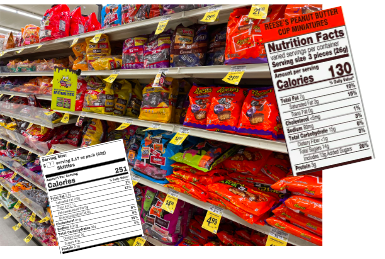
One bag of peanut m&m’s has 25 grams of sugar. Other healthier foods I consumer, such as plain yogurt, fruit, and salad dressing contain sugar, too, which result in exceeding my daily allotment. Shocked yet? I am.
The American Heart Association says sugary drinks are the greatest culprit of over consumption of sugar. The sugar content ranges from 51 grams in a can of 7-Up to 65 grams in a can of Mt. Dew, which is the equivalent of six donuts! Most surprising, though, is that a 15.2 bottle of Naked Vanilla Almond Milk Protein shake contains 47 grams of sugar! A protein shake should be our healthy option, yet the manufacturer has added an unhealthy dose of sweeteners.
Let’s apply the sugary cereal image to our morning coffee. Maybe this illustration will gross us out like the green barf and force us to consume less sugar. Compare our 20-ounce travel mug of coffee with a 20-ounce bottle of Arizona Iced Tea, which contains 59 grams of sugar! Most of us would never add 14 teaspoons of sugar to our coffee yet might drink a whole bottle of Arizona Iced Tea in a day.* I would never add six spoons of sugar to my coffee, yet I’ll eat a bag of m&m’s.
Lower Our Sugar, Regulate Our Emotions
I’ve seen young people’s personalities change in a matter of minutes after they’ve eaten sugar. Visit a school during late October/early November, and you’ll see evidence of how chaotic a place can become when most of the population is amped up on candy gathered from trick or treating. Cooperative behavior flies out the window like vampire bats. Kids are not the only ones. I’ll become more edgy after consuming too much sugar.
What’s most maddening is that food manufacturers are aware of the physically and emotionally destructive nature of sugar and yet make statements like, “there are no bad foods, only bad diets” (Krans, 2019). Sounds an awful lot like Big Tobacco stating smoking doesn’t cause lung cancer, doesn’t it? Meanwhile, companies spend millions of dollars advertising sugary treats to kids and place candy at the check-out area to encourage impulse buying.
Maybe we should reduce our consumption of candy and sodas to snub the companies that are manipulating us into buying more and more junk.
In fits of fancy, sometimes I wonder: Would we live in a more peaceful and self-regulated world if we didn’t consume so much sugar?
What Can We Do?
Eat less sugar.
This is not as easy as we’d like. Artificial sweeteners seem like a logical solution, however, current debate among health experts is whether artificial sweeteners produce a similar insulin response as real sugar. As nutrition experts sort this out, we probably are wise to steer clear, don’t you think?
When I’m tempted to buy candy or a fresh-baked cookie from my favorite supermarket, I say to myself, “I choose health.” It’s way better than telling myself, “I can’t have that.” This works at least half of the time, which is progress compared to a decade ago. Thoughts of my racing heart and joint stiffness are quite persuasive.
I’ve found two cookbooks that have many satisfying low-sugar recipes. They are I Quit Sugar, by Sarah Wilson, and Half the Sugar, All the Love, by Anisha Patel and Jennifer Tyler Lee. These sweet, low-sugar treats have helped curb my cravings. My sister swears by them, too. Many of the recipes contain coconut oil, which is a tradeoff of less sugar for fat. I consider it a wash if I calculate the candy (also laden with fat) I would have eaten if I didn’t have the satisfying substitutes.
Watch a Documentary Instead of a Scary Movie
My sister and I recommend, Fat: A Documentary.
Click on this link for additional documentaries about sugar.
To subscribe to these blogs, hover near the lower right corner, and click subscribe.
*Though measurements varied slightly in articles online, I calculated a teaspoon of sugar as roughly 4.2 grams.
Resources:
Krans, Brian. “America’s Deadly Sugar Addiction Has Reached Epidemic Levels.” Healthline, 16 Aug. 2019, https://www.healthline.com/health/sugar/americas-deadly-sugar-addiction, Accessed 7 Oct. 2023.
Gager, Erin R.D., L.D.N. “Finding the Hidden Sugar in the Foods You Eat.” The Johns Hopkins Hospital. https://www.hopkinsmedicine.org/health/wellness-and-prevention/finding-the-hidden-sugar-in-the-foods-you-eat, Accessed 7 Oct. 2023.
Bittman, Mark. Animal, Vegetable, Junk: A History of Food, From Sustainable to Suicidal. Harper Collins, 2022, New York.


 Fedore Writer
Leave a reply to Richard Draves Cancel reply