
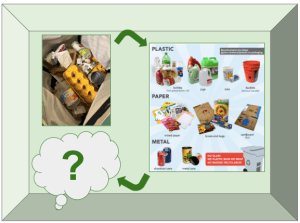
My sister and I, who share a home, swear that we must have been reincarnated from someone who lived through the Depression Era. We’re often amused with our diligence as we wash and reuse baggies and tin foil; save used ribbon, wrapping paper, and bubble wrap; tear dryer sheets in half; wash and reuse plastic food containers and jars; and use old washcloths and t-shirts for cleaning. We’re also avid recyclers.
Our actions are not about scarcity of money, as with the Depression, but are more about our finite world resources. Yet, when I tear out the plastic from a tissue box or scrape at peanut butter stuck in a plastic container, I wonder how powerful is the power of one? Why do I bother recycling?
I wonder this because I’ll notice fast-food wrappers and to-go cups discarded in our recycling bin–probably from our lawn–service person or technician who’s just been at our home. I’ll tip our bin and crawl in like an animal heading into its den to retrieve the soiling, invasive items. What’s most discouraging is this is not an isolated event. My sister and I walk our dogs to the local dog park and pass bin after bin, spilling over with grocery bags, containers with food still in them, and every type of plastic known to man, some which cannot be recycled and are transferred to the landfill.
Despite my discouragement, E.A. Crunden, in a 2021, Atlantic Monthly article states, “this simple act [of recycling] is popular with Democrats, Republicans, free-market diehards, and environmental advocates alike.” The bins out on the curbs every other week are evidence that we agree that recycling is important, but the soiled materials are a setback, nonetheless.
We single-home consumers should consider ourselves lucky that we have recycling infrastructures available and can reduce methane emissions from landfills and preserve natural resources. However, when I read that countries abroad are rejecting our recyclable materials because they’re contaminated, it’s hard not to resent the time I took to painstakingly prepare clean materials, and bitterly walk past those offending bins with grease-stained cardboard, yogurt-smudged containers, and soda still in bottles that soils my recyclables. Destroying clean, recyclable paper is especially irksome.
Why bother?
I bother because I can’t not recycle. It would take more emotional energy to just toss everything into the garage bin. Call me stubborn or stupid, but I can’t give up on the idea that we can fix our recycling practices. That each of us can make a difference, albeit it small.

Experts advise us to limit our use of materials in the first place. This is one solution to my recyclables being soiled. I’ll keep making the effort to reduce my waste, such as using fabric grocery bags, drinking water from a reusable container, and using my travel mug to get a latte or other to-go beverage.
“A 2020 Greenpeace USA survey found that plastics with resin codes #3–7 are virtually impossible to recycle” (Crunden, 2021). When I researched which plastics are recyclable locally, I discovered contradictory information. On the Pierce County Recycling Menu, we’re told to “ignore the numbers/symbols on packaging.” Yet, plastics that’re labeled PET, #1 and 2 are the most likely to be recycled. Plastic degrades after one to two uses, so if the caked on peanut butter is inside a plastic jar labeled with a #7, I’m tossing it in the garbage. Of course, I’ll feel guilty while doing so but will rationalize that I’m cutting out the middleman – the person at the recycling center who will toss the peanut butter container anyway.
I’ll continue to tear tape or plastic off cardboard because although soiled paper is discouraging, according to Rene Cho, in “Recycling in the US is Broken,” 30 percent of mixed recycling was rejected. That means 70 percent was recycled! Also, “paper and paperboard are among the more recycled materials, while glass has stagnated at about 25 percent. Plastics recycling rates remain under 10 percent” (Crunden, 2021).
Seventy percent of materials are being recycled? Pretty good odds. Good enough for me to bother.
To subscribe to these blogs, hover near the lower right corner, and click subscribe. You’re looking for this:

Primary Resources:
Cho, Rene. “Recycling in the US is Broken. How Do We Fix It?” State of the Planet. March 13, 2020.
Crunden, E.A. “How Useful is Recycling Really?” Atlantic Monthly. Jan. 28, 2021.
Davis, Jr., Elliott. “Some States Are Taking Action Against Climate Change, But Does It Matter?” U.S. News & World Report. Jan. 14, 2022.
Other Useful Sites: The US Recycling System Environmental Protection Agency, City of Tacoma Recycle Center, Plastics Pollution Coalition


 Fedore Writer
Leave a reply to Moumita Sarkar Cancel reply