
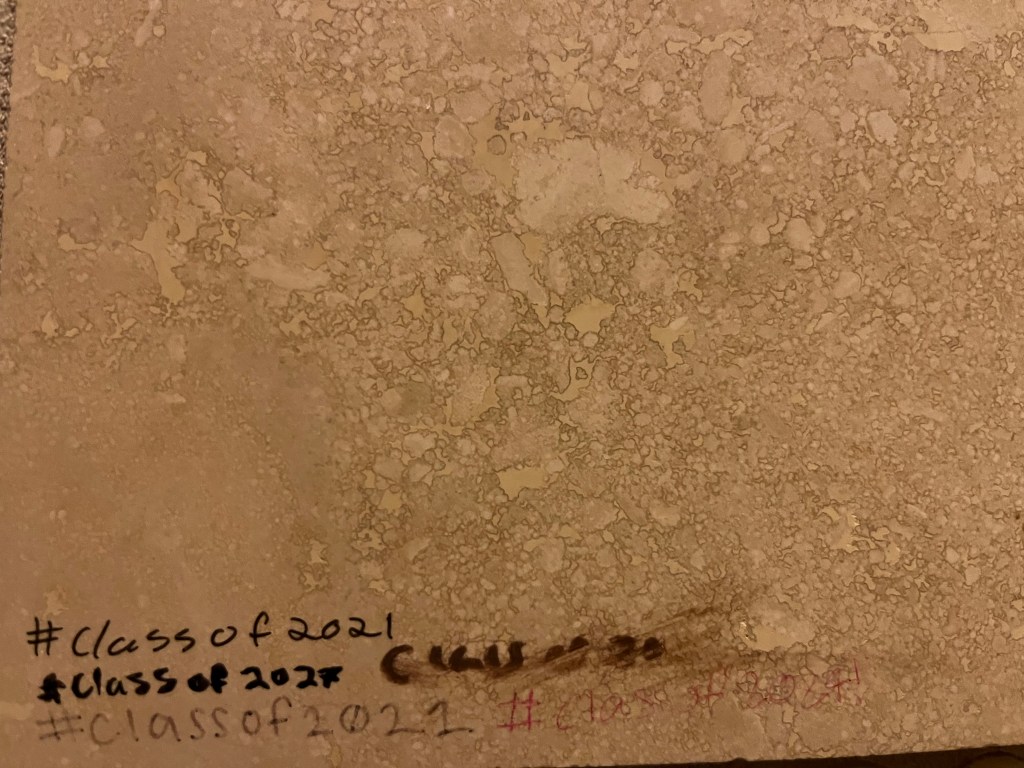
Recently, I was in a restaurant bathroom and on the wall was scrawled, “Class of 2021” and “Class of 2024.” This graffiti annoyed me because most young people have no concept of the time, cleaning supplies, and paint it takes to remove this blight. I know this because I was once a teenager and probably wrote on a bathroom wall and was clueless back then, too.
I also was a school administrator for seventeen years.
As a retired school principal, I’ve seen firsthand the time-consuming hassle of investigating and cleaning up graffiti. When it’s reported, as soon as possible, the principal, assistant principal, or custodian takes photos of the graffiti and removes it.
Unless a school has invited students to create murals on walls using the colorful and often artistic bubble-like letters and images, typically the presence of graffiti implies that order and civility are disintegrating and that others can also deface property. Malcolm Gladwell’s Tipping Point (2000) illustrates how small environmental factors can influence people’s behavior, such as New York City addressing graffiti and turnstile jumping, and, in doing so, reducing other more serious crime.
To add to the woes of school administrators managing adolescent impulses, a few years back, someone or some people on TikTok issued monthly challenges to create chaos in schools. One challenge was to vandalize bathrooms, take photos, and post on TikTok. Luckily, most students had school pride and good sense not to be swayed by these anonymous “influencers.” But there were always a few students that couldn’t resist the temptation.
Hours would be lost reviewing videos of activity in hallways to determine who entered and left bathrooms, checking students’ handwriting or doodles in their notebooks, interviewing students and staff to determine the time of the vandalism or graffiti, and who scrawled it. TikTok executives? I would have loved to have sent them the bill for our time and resources, but that’s a blog for another time.
Now, when I pass graffiti on our freeways, businesses, or neighbor’s fences, I’m appalled by the sheer volume of it. It was with a mix of relief and internal conflict that I read about the recent allocation of funds and resources toward a pilot program to paint over graffiti more quickly in Washington State and to prosecute perpetrators.
I empathize with law makers and law enforcement who are tasked with dealing with this crime. As a school administrator, I had limited time; time that I would have rather spent on building positive school culture and learning experiences, not dealing with something petty like graffiti. Nonetheless, we can’t allow people to deface other people’s and public property. It erodes our community.
Sometimes solutions were quite easy at school. One time, I asked the tallest student in the middle school to take a walk with me down the hallways. We stopped in front of a drawing above the lockers, and I said, “You’re the only student that could have reached this high to draw this. Can you see my logic?” The student admitted that he’d drawn the graffiti and other drawings like it. He promised to not deface school walls again and held true to his oath. If only investigating graffiti and stopping it from happening was always this easy.
The high school I graduated from offered a designated Senior Wall, where graffiti was allowed. This probably curbed markings elsewhere, but I recall a few Sharpie scribbles on my friend’s and my locker.
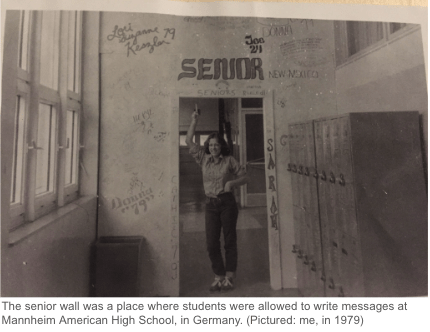
I have another solution for present-day graffiti. Gazing at the penned messages in the restaurant bathroom, I smirked as I imagined writing, “Class of 1979,” which I was sure would stop any further graffiti because an old person joining the fray is not cool. Not cool at all. As I considered this, I remembered joking with dance chaperones that we should go out on the dance floor and twerk and jerk. The students would have been so grossed out never to dance like that again.
Maybe a solution for our freeways is for a bunch of retired people to go out one night dressed in suits, and matching sweater sets and pearls to spray paint a wall, scrawl names like Granny or Grumpy Old Man, and post it on social media with us posing in front of the messages. That should put a stop to this problem.
In the meantime, it’s a shame that we must direct a million dollars toward cleaning up graffiti instead of allocating those funds toward providing mental health support or food to people who need it.
“Inslee signs bill to combat graffiti in Washington with innovative pilot program.” KOMO News. March 21, 2024. “Graffiti-battling drones take flight in highway clean-up program.” KOMO News. May 14, 2024. Paul, Andrew. “Washington State deploys $30,000 drone to combat graffiti.” Popular Science. May 13, 2024.


Leave a Reply