

During recent travels to Vietnam and Cambodia, my sister and I faced surprising challenges to having perspective. You’d think I’d be practiced at this from experiencing a variety of cultures and having worked in education for 28 years, guiding students to take the perspective of and empathize with others from diverse backgrounds and cultures.
Growing up in a military family, I lived in different parts of the U.S., England, France, and Germany. I understood what it was like to adapt to accents, customs, and languages.
I could not have predicted my limited perspective while visiting Vietnam and Cambodia where I absorbed most of my experiences through a singular lens: the United States. For example, our hotel room in Hanoi was on the seventeenth floor, which gave my sister and me the opportunity to gaze through an elevator window toward the Truc Bach Lake below. The lake which John McCain plunged into after ejecting from his fiery, failing jet, in October, 1967. As we rode the elevator, we imagined angry North Vietnamese swimming out into the lake to pull McCain onto the shore to deliver him to authorities who would throw him into the rat- and roach-infested Hanoi prison, which the American POWs nicknamed The Hanoi Hilton. How terrifying these experiences must’ve been.
We learned of a monument for John McCain near an historical pagoda, which we could see from the elevator. We imagined it to be a tribute to McCain’s righteous refusal to use his father’s position as an admiral to be released from captivity or a tribute to McCain’s survival of injuries suffered while ejecting from the jet, North Vietnamese beatings when captured, and torture in the Hanoi prison.
Instead, the small monument “celebrates the downing of McCain’s plane. ‘The citizens and military caught Pilot John Sidney McCain,’ the statue’s engraving says [in Vietnamese]. ‘This was one of 10 aircraft shot down that same day’” (Watson, 2018). It has since become a shrine to McCain post-houmously, demonstrating that perspective can be found decades after an event.
While touring the Hanoi Hilton, we saw Vietnamese mannequins bound in shackles, faded blood stains on the floors, and dark rooms. We also saw U.S. POWs playing chess and smiling from cots as shown in photos hung on the prison display boards. Had I not been taught another perspective in school, I might have believed that this prison was a humane place for Americans.
Let’s face it, most countries wish to erase some of the horrors of their own history, yet the truth has a way of surfacing. As it should.
Then, days later, we visited the Cu Chi Tunnels, the location where our dad served the Army, in 1969. With thoughts of my dad and my stomach clenched, I listened to accounts of ingenious traps and hidden tunnels. Hearing this wasn’t easy, especially when this tour focused only on the ingenuity; not the number of lives lost on both sides. Maybe it was best not to go there.
Our tour guide informed us that Vietnamese citizens call the Vietnam War the American War since their country has fought other wars on their soil. It never occurred to me that everyone didn’t call it the Vietnam War. Again, my sister and I were reminded that not everything flows through a U.S.-oriented lens.
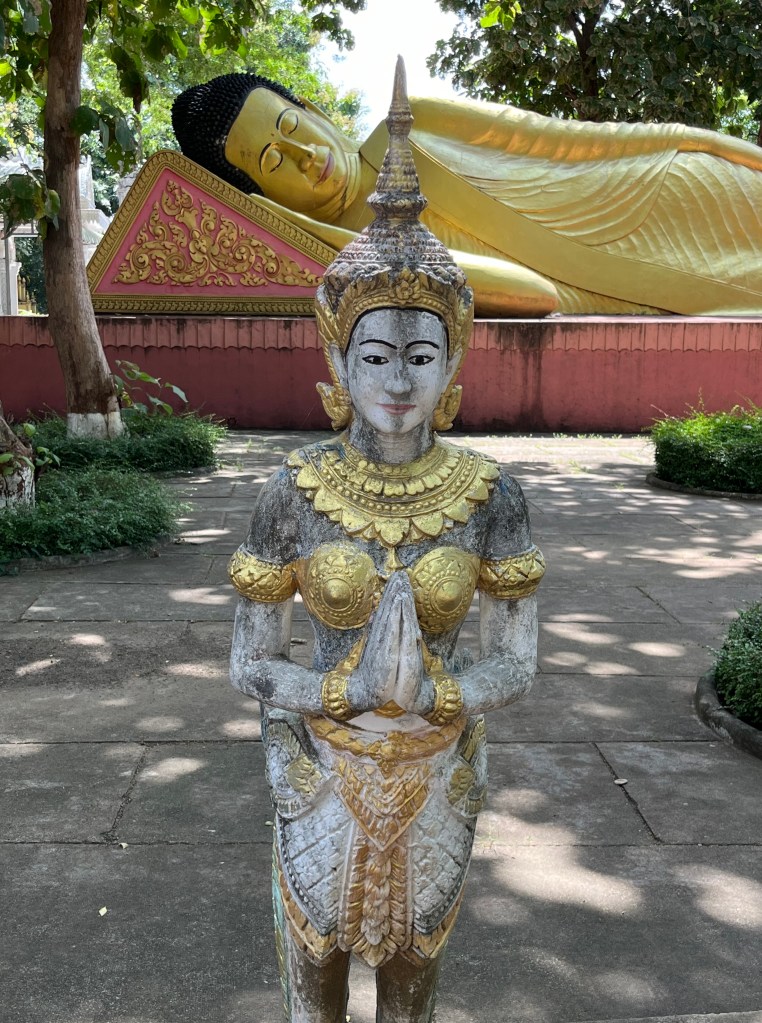
Cambodia held the same lessons for empathy as Vietnam. Before traveling to the Killing Fields, we stopped at a Buddhist garden with several statues and shrines where I stood reverent, saying a silent prayer for up to three million people slaughtered. But then comical monkeys entertained most of us in this garden. I apologized to our Cambodian tour guide for seeming insensitive. She told me it was okay and pointed to local teenagers that were screaming because a monkey had stolen a motorbike helmet. I suppose we all need a reprieve from solemnity.
The bleakest tour was the Killing Fields, in Cambodia. I gazed upon a horrifying wall of human skulls and walked on a path, conscious not to step on visible splinters of human bones. Listening to our Cambodian tour guide describe the slaughtering of men, women, and children during Pol Pot’s rule, from 1975-1979, I pondered that I was in high school while people were suffering and being murdered under an autocratic regime. I had no clue back then. Maybe I was daydreaming during a current-events lesson.
While there were days of grief, there were days of relief. Perhaps when faced with bleak history, the celebration of resilience and growth is richer.
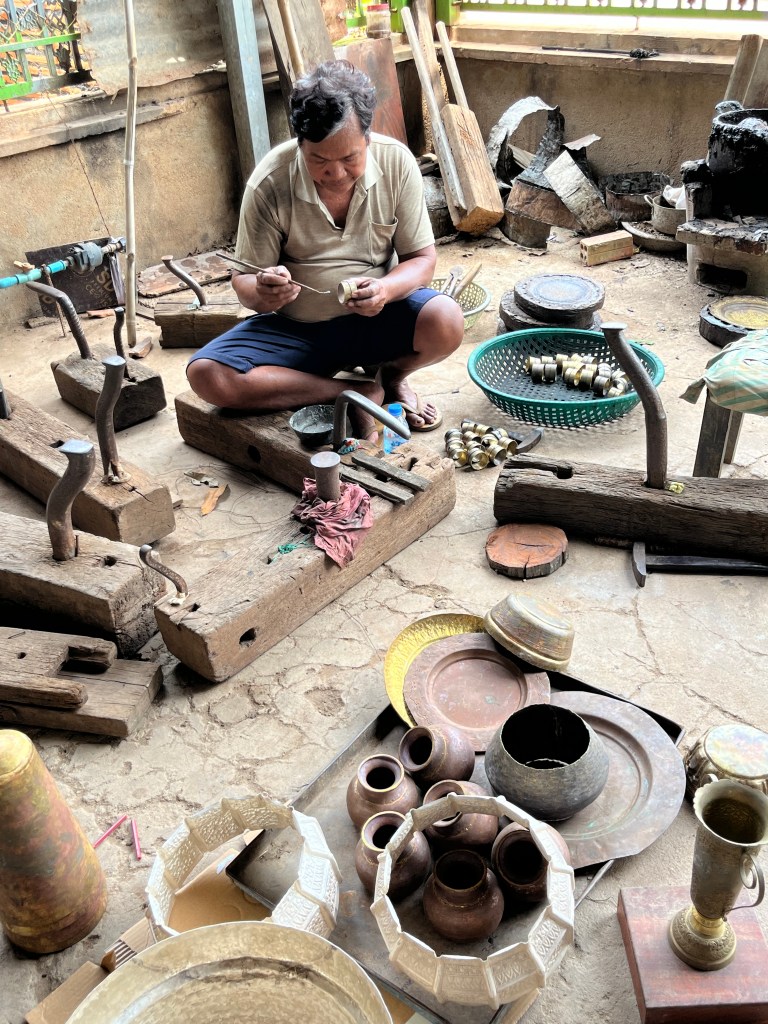
We visited palaces, mausoleums, and centuries-old sacred sites, such as Angkor Wat and Bayon Temple which were demonstrations of magnificent architectural minds. We witnessed people in both countries eking out a living in every possible way, ranging from cooking to crafting exquisite art.
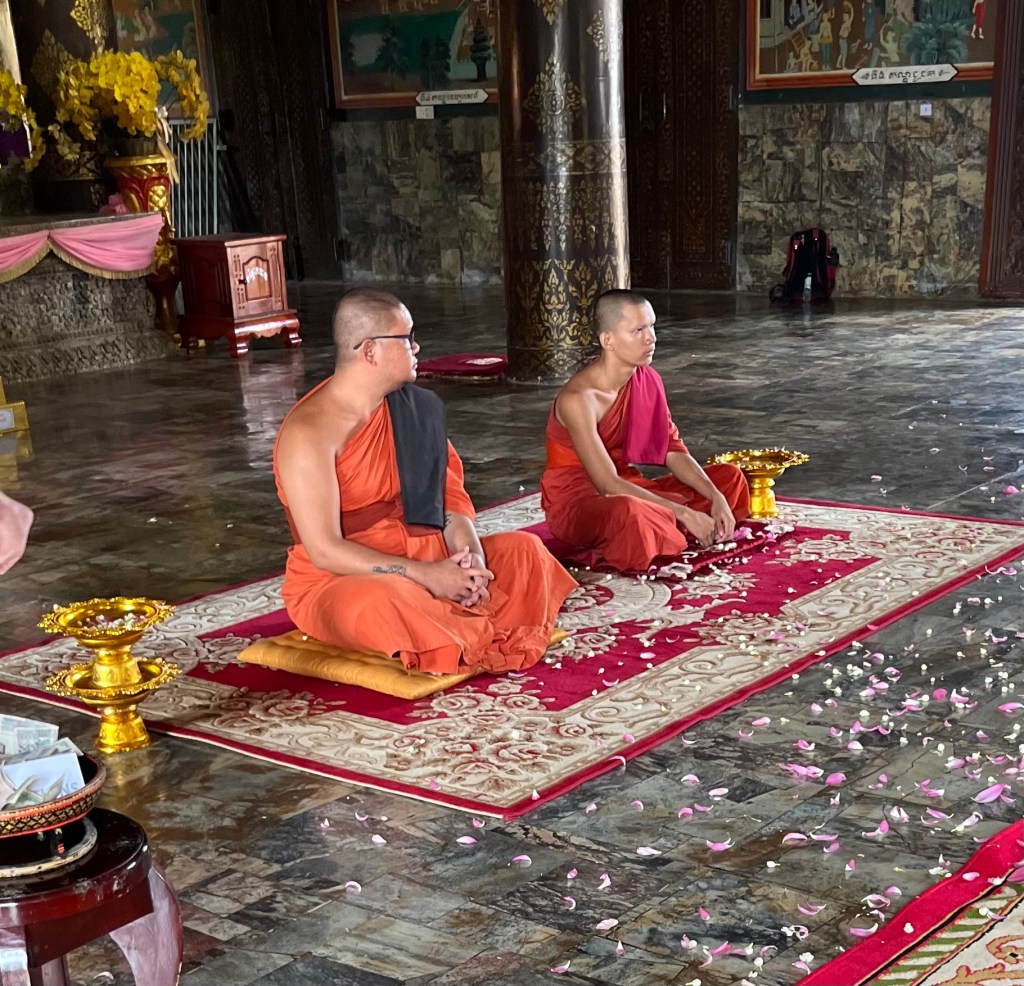
My sister’s and my favorite part of the two-week trip was visiting a beautiful monastery where our tour group members sat on a carpet and two monks chanted a Buddhist blessing, sprinkling us with jasmine petals and water. The resonance of their mingling baritone and tenor voices cast away sorrow and gifted us with what felt like purification.
After each tour, we’d climb back into the bus or onto a sampan (boat) where I reflected on what I’d seen and heard. The most prevailing thought I had was that we need to know all that history has to offer. Even the discouraging, disgusting, and disorienting. There were times when I wished I had been lying on a beach, reading a distracting book, instead of hearing and seeing evidence of the worst of humanity. Yet had I been lying on a beach, I wouldn’t have had the opportunity to see gaps in perspective and empathy.
Watson, Ivan; Shelley, Jo; and Phillips, Mark. “John McCain remembered in Vietnam as a friend, not an enemy.” CNN. August 30, 2018. (Our tour guide also contributed to this article, as noted at the bottom of the post.)
To subscribe to these blogs, hover near the lower right corner, and click subscribe. The tool should look like this:


 Fedore Writer
Leave a reply to sonyashannonartist Cancel reply