
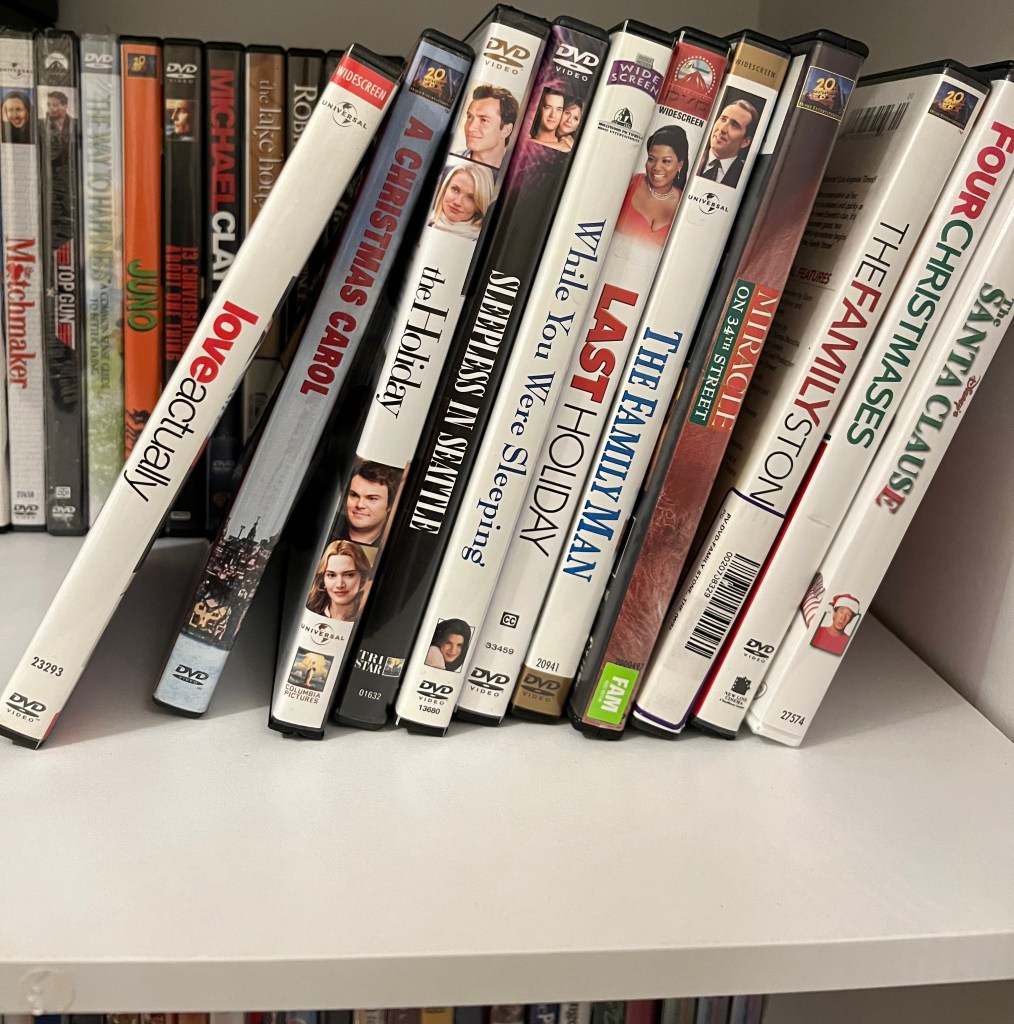
“I got a real compliment for you…”
“I’m so afraid you’re about to say something awful.”
I fell asleep again only to wake up to hear, “My knees go when you turn on the charm full blast.” Exhausted, I missed at least half of the dialogue in this classic Jack Nicholson and Helen Hunt movie.
Napping during a movie happened a lot when I was a high school administrator. I didn’t bother subscribing to cable TV and, instead, watched the same Blockbuster DVD movies and series year after year. Pushing through an average work week of up to 65 hours, at home slumped on my couch, I’d intermittently snatch glimpses of periodic scenes. I didn’t mind. I had basically memorized the plots, dialogue, and settings.
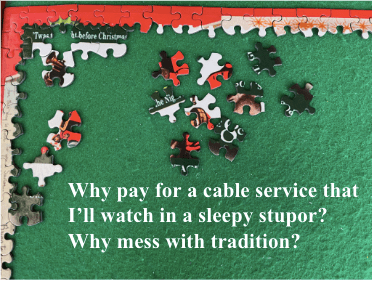
Now that it’s December, I’m immersing myself in predictability again. I tolerate–and even enjoy–formulaic plot lines of Hallmark holiday movies. Furthermore, my sister and I piece together our same ol’ wintery puzzles, starting with “Winter Dogs” progressing to more Christmassy scenes as December twenty-fifth approaches. We also prepare our traditional recipes, host the same events, decorate the same way, and play the same music.
All this time, I’ve attributed these practices to financial practicality and sentimentality. Why pay for a cable service that I’ll watch in a sleepy stupor? Why mess with tradition? It turns out, there’s more to habits than I knew. Spurred by a Facebook post about watching favorite movies to “feel safe in an unpredictable world,” I’ve explored the notion of familiarity.
In a March 2023 blog on VeryWellMind, Kendra Cherry shares that “tuning into a favorite TV show can be a great way to soothe stress” especially when feeling depleted. She goes on to describe that our brains can process only so much and that watching something familiar allows us to use cognition for other needs.
This makes sense. It explains why, when I was working as a principal, I didn’t crave new shows on cable TV and instead found solace in watching movies like As Good as It Gets, Anne of Green Gables, and all six seasons of Sex in the City for the tenth time. It explains why silently reciting the lyrics to Don McLean’s “American Pie” instead of counting sheep helped me fall asleep. I was a kid in the ‘70s who would lie on her bed, relaxed and absorbed, listening to hours of music–an escape from every-day stressors. Reciting this song brings back those relaxed feelings. Cherry says when we have familiarity, it “seems less threatening and anxiety-provoking.”

Familiarity isn’t always favorable. Our brains prefer predictability, but this discourages us from enjoying new experiences. In Charles Duhigg’s The Power of Habit (2012), he writes about the challenge of introducing a new song to audiences on the radio. OutKast’s 2003 “Hey Ya,” didn’t catch on until it was sandwiched between two familiar popular songs to make it “sticky”–likely to be a hit. Even though the music business has changed in the past two decades, our brains process and, at times, reject information much the same.
Familiarity is tradition, family, routine, books read and re-read, jokes told and repeated, friends, walking routes, closets organized… All good things, however according to Cherry, “it’s easy to get stuck in a filter bubble.” Inspired by Cherry’s blog, I’ve started watching a different news program to better understand other views. It’s uncomfortable. So much so, my thumb itches to switch back to my familiar channel. I like my news anchors with their predictable cadence and angle on stories. Yet, I want and need to broaden my perspective. I guess I’ll just sandwich the news between two shows I’ve seen before. With familiarity and repetition, the dissimilar news program might stick.
Sources: Cherry, Kendra. MSEd. “Mere Exposure Effect: How Familiarity Breeds Attraction.” March 17, 2023. https://www.verywellmind.com/mere-exposure-effect-7368184
Duhigg, Charles. The Power of Habit. Random House: New York. 2012.
To subscribe to these blogs, hover near the lower right corner, and click subscribe. The tool should look like this:


 Fedore Writer
Leave a reply to eileenshine Cancel reply