
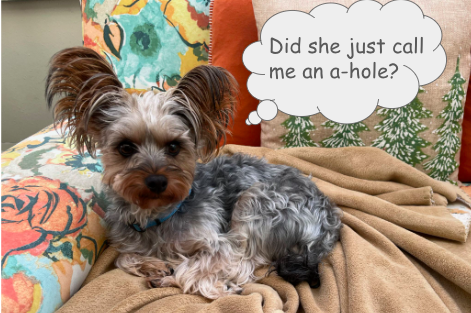
I’m crawling into a shrub, my shirt dampening with dew from its leaves and my ponytail unraveling in the branches. I’m pulling my Yorkie away from cat feces that he’s attempting to eat, and I’m throwing down a few cuss words. “Cat poo” doesn’t cut it. Neither does “darn it.”
I’m carrying my Yorkie away from the disgusting mess in our yard, returning to our house to retrieve a bag, shutting my dog inside, and crawling back under the shrub to remove someone else’s cat’s feces. Of course, I’m adding a few more cuss words.
But then … remorse sets in.
I envision neighbors on the other side of the fence arching their eyebrows at my expletives. Is it healthy to cuss? Do we need this release valve? Or does cussing minimize our impact as communicators? Does it project our stress onto others?
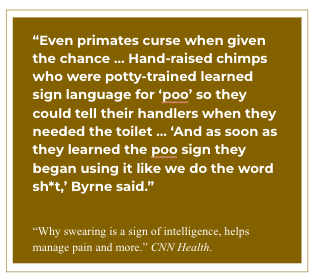
To explore the social construct, my sister, Karen, and I have been listening to a 2023 Freakonomics podcast and appreciating the rationalization for our cussing. When professor emeritus Dr. Timothy Jay, world-renown expert in cursing, says profanity is a normal behavior, it’s worthy of a validating fist bump.
In addition, in a 2021 CNN interview, Dr. Jay said that:
- Cursing may be a sign of intelligence,
- Swearing may be a sign of honesty,
- Profanity improves pain tolerance,
- Cursing is a sign of creativity, and
- Throwing expletives instead of punches [is a better option].
Thank you, Dr. Jay. Sure, cussing isn’t necessary, but it’s satisfying and often funny with the right people. Karen and I cuss often in each other’s company and it’s part of our culture, our schtick. We’re letting off steam about something–usually politics. Or on occasion, I’ll call my cute little Yorkie an a**hole when he’s being naughty. It makes me laugh. Every time.
If Dr. Jay says swearing is considered normal, why do I feel remorse when I cuss around some people? When our brother, Len, who’s no prude, considers cussing as unnecessary or my grandnephew says, “That’s a quarter,” when a cuss word slips out in front of him, my habit is worthy of examination.
I recently asked my former assistant principal if he minded that I occasionally used cuss words to describe situations. He said he understood that it was a necessary release valve but admitted that sometimes it made a situation more stressful. The last thing I wanted to do was add to someone’s stress.
Chris Westfall, in his 2022 Forbes blog, asks, “Are your words … diminishing your effectiveness? What happens when you receive collateral damage from your latest f-bomb?” Valid questions. Perhaps, in the work setting, I should have found substitutes for reducing stress. In my defense, I usually said, “Mo-fo,” instead of the actual f-word. Other alternatives, such as taking a walk, would have taken more time and thought when I just needed a one-second eruption.
I’m justifying my behavior. I know I am.
According to a google search, 65 percent of people over fifty-five self-report they’d never curse in public and 25 percent of eighteen to twenty-four-year-olds would never curse. So, 35 percent of people in my age bracket cuss.
That statistic isn’t very flattering. I’m in the minority. I have the self-control to not cuss. But cussing is a conscious choice, especially when I’m picking up smelly cat sh*t and my dog has diarrhea from eating it.
When I cuss around my sister or friends that also cuss, I feel less remorse and often a satisfying release. Yet, even though my foul words are justified as I pick up smelly messes in our yard, my guilt over burdening other people with hostile language makes me feel like a heathen. When I cussed at work (where statistically people are most likely to cuss), I also felt like a heathen.
When Cussing Starts
The average age for kids to start swearing is eleven. This fact rings true when I recall my siblings’ and my fascination with cursing in another language. When we lived in Europe and tried out German or British swear words, it was like a get-out-of-jail-free card. Our dad would sneeze and jokingly say Ah-scheizah (spelled phonetically). My siblings and I always laughed and felt the tingly thrill of something taboo. We occasionally tattled to our mom, which was part of the joke. We also relished saying knickers and bloody hell. According to us, it wasn’t technically swearing, although my British cousins thought differently.
My grandnephew is eleven. I’ve always been conscientious with my language when I’m with him, but sometimes I’ve slipped up and paid him a quarter. Now, it is even more important to curb my swearing and not solely because of the money.
While in public, I’m joining the majority and am not going to swear. “Cat poo” is going to have to be enough because my remorse is greater than my reward. But in private and in the company of people that cuss, I’m going to let ‘er rip.
Sources used: Westfall, Chris. “A Frustrated Workforce Finds Potent Release Inside Cursing and Swearing.” Oct. 25, 2022: Forbes Magazine. https://www.forbes.com/sites/chriswestfall/2022/10/25/a-frustrated-workforce-finds-potent-release-inside-cursing-and-swearing/.
“Swearing is More Important Than You Think.” Freakonomics podcast. April 19, 2023. https://freakonomics.com/podcast/swearing-is-more-important-than-you-think/
LaMotte, Sandie. “Why swearing is a sign of intelligence, helps manage pain and more.” CNN Health. June 1, 2023. https://www.cnn.com/2021/01/26/health/swearing-benefits-wellness/index.html
To subscribe to these blogs, hover near the lower right corner, and click subscribe. The tool should look like this:


 Fedore Writer
Leave a reply to Sonya Shannon Cancel reply