
I don’t know about you, but I’m on information overload. I thought a short story might be best for this month.
The first to arrive was Mrs. Clenner, from across the street.
“I’ll give you eight dollars for this sweater,” said Mrs. Clenner, with the horsy teeth and yappy dog, according to Helen’s mom.
“Ten dollars. As posted,” Helen’s mom said.
“Eight fifty.”
“Ten.”
“Nine dollars,” Mrs. Clenner said, with her feet planted on the pavement. “My final offer.”
“Ten dollars. My final offer.” Helen’s mom remained seated.
Mrs. Clenner dropped the sweater onto a pile of five others she’d selected, pivoted on her heels, and said a brisk, “goodbye.”
“I never liked her,” Helen’s mom said as she inspected her nails. “Huge smile on the outside; huge grouch on the inside.”
Helen, who straightened the disheveled sweaters, shrugged. Mrs. Clenner had been friendly to her as a child, but why argue with her mom? Helen seldom won an argument. And even when she had, she bore her mom’s silence or subtle slights afterward. Today’s goal was to endure the all-day yard sale, to help her aging parents and ease her conscience in doing so, and to keep the peace. Judging from her mom’s interaction with Mrs. Clenner, it was bound to be a challenge.
Seated in a dining room chair, Helen’s mom turned to her daughter. “And did you see her caterpillar eyelashes?”
Helen looked at her mom. “Huh?”
“Those fake eyelashes. A woman her age shouldn’t be wearing those.”
“Does it matter?” Helen hoped her question didn’t spark a debate.
Helen’s mom raised her pencil-enhanced eyebrows and stood, smoothing out her pleated slacks. “Well, she ought to care how it looks. . . Here. Let me help.” Helen’s mom lifted a sweater and folded it with military precision.
They both stood next to each other refolding sweaters, fanning them out for the greatest visibility. Not able to withstand the momentary silence, her mom said, “Aren’t these decadently soft?” She ran her hand over the sweaters like she was petting a dog.
Helen sighed, then said, “Yeah, they’re soft.” She recalled hour after hour shopping with her mom and feeling every texture and fold of fabric that had been shaped into clothing and marveling at the sheer volume of products set out for buyers to touch, try on, and take home.
In the next hour, four more neighbors stopped by her parents’ yard sale. Each neighbor haggled for lower prices, and each were denied. Helen chatted with the neighbors, hoping her polite banter would offset her mom’s insistence. Three paid the asking prices and one left without a purchase or another word.
After straightening out kitchen wares and shoes, Helen returned to her dining room chair and sat on top of a ridiculously expensive cushion that should have been displayed on a table, but comfort was a priority when at least eight hours were spent under an awning, amid overpriced, impractical, and, in some cases, gaudy items. She needed to sit to rest her legs and back, stiff from a week of cleaning and rifling through limited-edition crystal figurines, forgotten original paintings and prints from local galleries, and stacked dishes and impractical kitchen gadgets.
During that week, her mom had said, and said again, “Take what you want, Helen.”
“There isn’t much I want . . . or need,” she’d said. What she’d wanted to say was, “How could anyone need all this crap?” To stop her mom from saying “take it” one more time, she’d surrendered, and accepted a cluster of spatulas with whimsical zoo-animal heads, which her mom had paid three times as much as Helen would have paid for tools that scrape batter out of a bowl. After flipping through a dozen or so limited-edition pieces of artwork, she’d chosen two modest prints and promised to find space in her condo. She had paused at one print of a painting that had hung in the living room when she was a child. The razor-sharp crests in the waves; the looming, dark clouds; and a ghostly and treacherous rock had sped up her heart and set her off-kilter when she had gazed at it with her wild and youthful imagination. Her eyes would dart back and forth like a speed reader and then rest upon the lighthouse beam that pierced the clouds beckoning tossed and terrified sailors to safety. If she focused on the light, her craggy breath would return to normal. Only then could she pull her gaze away and leave the room. Always unsettled. Never comforted.
The awning cooled the ninety-degree afternoon to a more bearable seventy-five. Still, beads of sweat gathered at her brow and on her upper lip as she sipped water with withered ice cubes. Her salt-and-pepper hair was pulled into a ponytail, and she wore a tank top, skort, and sensible sandals.
After numbing silence and no buyers for close to an hour, her mom said, “Maybe if you’d worn better clothes and dressed the part, people would have offered to pay full price.”
Helen guessed that her mom had stewed over this for most of the morning, her ire increasing in the heat of the sun. “Mom, people come to yard sales expecting to pay one to three dollars.”
“For stuff like this?” Her mom swept her hand from left to right like a magician. “No.”
As if on cue to prove Helen’s point, an eBay seller dropped by, gathered at least twelve blouses, and offered her mom two dollars per designer blouse and jacket. “These cost over a hundred dollars apiece!” her mom protested. The eBay retailer lifted his hands, palms up, and said, “People aren’t paying half of what we’re asking.” He collected four handbags, all dangling from his fingers.
Her mom folded her arms across her chest and said to her daughter, “I guess it’s better than donating it at the end of the day.”
The e-Bay seller handed over two twenty-dollar bills and walked away with a U-Haul box full of mint-condition fashion.
More buyers should have come to whittle away the volume of items. Helen had advertised the yard sale on every free online source she could find with photos of the sumptuous wares. She had written clever, eye-catching signs and posted them at busy intersections. But this wasn’t the kind of neighborhood for an estate sale where people swarmed to discover unknown antiques and collectibles. This was a neighborhood where neglected, idle vehicles collected rust and rats.
Yet, here on display were paintings, crystal vases, designer shoes, and designer pillows––out of a house with an unexpected treasure trove of beautiful, artisan embellishments.
From a few feet away, another neighbor asked her mom, “Would you take five dollars for these pillows?”
Her mom perked up after sitting inert for at least an hour. “They’re from West End,” she said as if this buyer would offer more than the asking price of ten dollars each. “I tell you what. If they don’t sell by the end of the day, let’s talk.”
The neighbor’s shoulders deflated as she turned away, perhaps to hide her discomfort with bartering with someone she’d known for two decades. Then, the neighbor clattered and clinked at the kitchen-wares table, lifting, inspecting, and setting down each bowl and pan.
The daughter leaned, draped her arm over the back of her chair, and whispered to her mom, “Did the pillows bring you joy?”
“Of course,” her mom said. “They’re beautiful.”
“Okay then,” she continued, “let her have one for five bucks and throw in an extra one for free.”
“What?” her mom said, hitting at least three octaves with this single word.
“With the joy, you zeroed out their value,” her daughter said. “You should be giving away this stuff.”
“I paid good money for these things.”
“True. People at a yard sale? . . . They aren’t going to pay more than five bucks for a pillow.”
Her mom huffed, got up from her seat, and approached the neighbor.
Helen couldn’t hear the conversation but saw the neighbor smile, hug two artfully shaped and tasseled pillows to her chest, and hand her mom five dollars.
Helen’s mom plopped back into her chair next to her. “Happy now?”
“The question is, are you?”
A fly buzzed nearby. A car engine roared a few blocks over. Finally, her mom said, “I suppose so.”
Helen stood to break the tension, to stop from saying something she couldn’t take back. For hundred-dollar pillows, ten dollars, five dollars, or no dollars––there wasn’t much difference at this point. The money had already been spent. The credit card bill paid. Her mom wouldn’t see it this way. Not in this lifetime.
Helen walked toward the paintings and sketches that were lined up, leaning on shrubs along the driveway. To the untrained eye, these were pictures of forests, blossoms, and a storm. To her and her mother’s eye, these were rejected heirlooms. If only she’d had a sibling, someone who might have wanted some of this excess. It would have eased the pressure on Helen.
“Helen. Will you come here?”
She glanced back to her mom who was sitting, holding court over her domain, her possessions. Her mom waved her hand and snapped her fingers. When Helen arrived, her mom gripped her upper arm and hissed, “Keep an eye on that one.” Helen followed the direction of her mom’s stare and saw a moppy-haired teenaged boy, maybe fourteen or fifteen years old, picking up figurines and gently setting them down.
“Mom.” Helen glared at her and whispered, “He’s fine.”
Her mom’s eyes widened. She rasped, “He is not! He’s trying to put one in his pocket!”
Helen’s fingernails dug into her palms, just like they had year after year living in this house. She stepped away from her mom, and said to the teenager, “Hi, I’m Helen.”
“I’m Tanner,” the boy said, not looking up from the figurine.
She watched him rotate his wrist to inspect all angles of the clear and black crystal penguin that he cradled in his hand.
“I’m in a pottery class and I’m getting ideas for what to make next,” he said.
A shard of a recollection sliced her thoughts as she observed this boy. She had been forbidden to touch anything of value when she was his age for fear she might break a figurine that was now sitting on the ten-dollar shelf.
“What do you like about this penguin?” Helen noticed the boy’s graceful movements as he handled these fragile figurines, tactile actions of an artist.
“I like that it is and isn’t a penguin,” he said.
She had a sense of what he meant by this and considered letting his comment rest in its profound simplicity. She couldn’t resist and asked, “Say more about that.”
“Well . . . it’s just a shape. Our eyes fill in the rest.”
Helen assessed this young man with his frayed shirt cuffs, unwashed jeans, and soulful eyes that had probably seen more than a teenager ought to see, especially if he was from around here. “You like abstract art, then?”
“Abstract?”
Naming the art rather than just appreciating it had ruined the moment. She winced at sounding pretentious. She should have just listened to what this boy had to say. “Forget I said that. What matters is that our eyes fill in the rest. I like that.”
“I was checking out this one, too.” The boy held up a fiery orange serpent. “How’d they get this texture? And I love the color.”
She had hated this dragon-like figure when she was just a girl. Its fangs and claws threatened to jab at her, like a person with a hair-trigger temper, so she’d never lifted it off the shelf. Fearless and curious, this boy held it, peered at its underbelly and inside its mouth.
“Orange. So unexpected,” he said, smiling.
She could have listened to this boy’s observations for the next hour, but her mom was glaring at her, telepathically communicating that she needed to make a sale. She was at this sale to help her parents close out their lives in this home. With elderly parents, it was best to do their bidding in case it was the last chance to pay homage.
“Are you thinking about buying one of these?” Helen asked, but she knew the answer. His family couldn’t afford a new shirt or laundry detergent, let alone a frivolous figurine.
The boy turned his head toward the paintings leaning on the shrubs and back to the shelves. “No. Like I said, just getting ideas.” He set the serpent back on the shelf, tapped its head twice, and shuffled down the driveway.
Standing next to the shelves of the dozen or so figurines that brought her no joy growing up, she watched Tanner pause in front of each painting and print as if he were visiting an art gallery. Like a camera zooming in and out, he shifted closer to each image and then stepped back for a panoramic view. He stopped in front of the stormy lighthouse painting and shoved his hands into his pockets. He rocked back and forth, from his toes to his heels, as if he was being tossed in the sea. Helen wondered if his heart sped up as well. His rocking stopped, and she wondered if he was focusing on the lighthouse.
“Did you check the figurines?” her mom stage-whispered, interrupting her daughter’s thoughts. Thank God no other buyers were present except for the boy, who was at least twenty feet away and couldn’t hear her mom.
“You mean, are they all there?” Her nails dug into her palms again.
“Yeah.” If her mom had been a teenager, she would have said, “Duh.”
“He was just looking. . . Admiring the craftsmanship.”
“So, he says,” her mom said, with eyes slit.
“How’s your search going?” Helen said to steer the subject to a safe port.
“We’ve narrowed it down to a retirement community a few miles from here and one near Olympia. Both have daily activities and no yards to tend, thank God. There’s a resident painter that teaches art classes at the Olympia place.”
“You’ve always loved art,” Helen said.
“I’ve loved investing in it.”
Without meaning to, Helen’s head swiveled in the direction of the limited editions lining the driveway and she noticed the boy was gone. Fifteen-dollar price tags were taped to each piece of artwork. Hardly an investment.
“You sure did. Supporting artists is a good thing,” Helen said. Although she meant this, she liked Tanner’s way of appreciating art better. He didn’t have the terminology and didn’t know the monetary value of those figurines he had reverently held in his hands. He just knew beauty and artistry.
Her mom sighed. “I wish you would have wanted all of this. ‘Tossed and Lost’ is number two of a hundred. Number two! It’s worth a fortune by now.”
Helen had researched art sales as she prepared for this yard sale and learned that with the advancement of the printing process, the lower numbers were not synonymous with a greater value. She didn’t argue this with her mom. Her mom was seventy-three; what did it matter who was right?
She and her parents had discussed working with an auctioneer and decided to avoid the hassle of hauling all these goods to other locations for an extra few hundred dollars.
“To own art, Mom, I need an emotional connection.”
“You have an emotional connection. That painting belonged to your dad and me. You should take it. Go put it in your car before someone snatches it up.”
Helen sat in her seat facing her mom. She shook her head. “I didn’t love that painting when I was a kid. It was unsettling. Still is.”
“Unsettling?” Her mom’s eyebrows pressed toward each other. “It’s beautiful. Evocative.”
“Perhaps,” Helen said. “Not for me.”
“Take it! I insist.” Then, without warning, her mom reached out and pinched strands of Helen’s hair between her finger and thumb. “You’re due for a haircut.”
Helen sighed. “At fifty-two, I can decide when I’m due for a haircut.”
“You need a dye job, too.”
“It’s expensive,” Helen said.
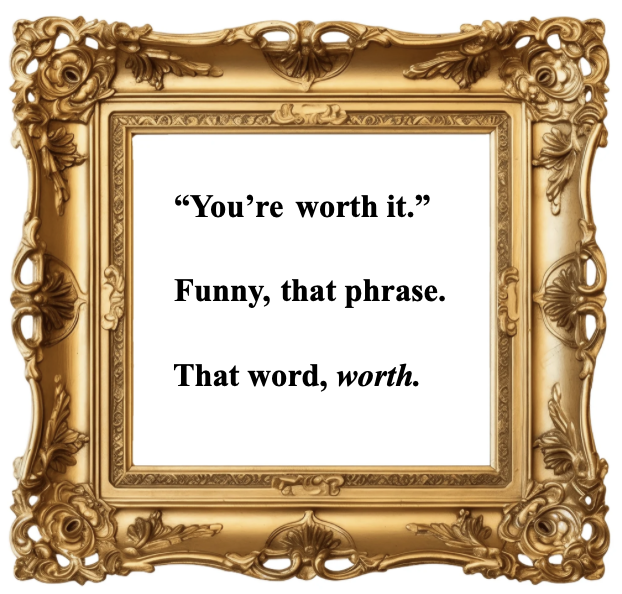
“You’re worth it.”
Funny, that phrase. That word, worth.
Helen didn’t venture further into the familiar conversation about her appearance. “If the ‘Tossed and Lost’ painting doesn’t sell by the end of the day, I’ll take it,” Helen said. And let it sit in a closet for a few years and then take it to a charity. She tapped her phone; it was just past three o’clock. Two more hours and she and her mom would shove all the excess into her car. “From the looks of it, I’ll be making a few trips to Saint Vincent’s.”
“There’s not that much here.”
“Two trips, mom. Might even be three.”
“Then, let your dad help,” her mom said.
“Just let him rest, okay? I’ll be fine.”
Her dad had undergone open heart surgery a month prior, and his recovery was slow. His failing heart and both of her parents’ ages had prompted them to give up a house that required more maintenance than two people in their seventies ought to manage. Helen lived an hour away and wasn’t nearby to help with chores, which added a dose of guilt about not helping enough. She had traveled more miles in the past few weeks than she had in two months. Time on the road wore her down and made her look “old,” according to her mom.
“Your dad is fine and––”
Helen followed her mom’s stare.
“What’s that grubby waif doing back?”
Helen saw the teenager had returned and was standing at the end of the driveway. “Saved by the boy,” she muttered. Helen set her hand on her mom’s arm. “He loves your art.” She stood, approached Tanner as if she was taking a leisurely stroll, and stopped next to him. “Good to see you back,” she said with a smile.
“I asked my dad for a few bucks,” the boy said, and his face reddened. The boy dug into his pocket and pulled out four limp, wrinkled dollar bills. Then, he reached into his other pocket and said, “My sister let me borrow from her piggy bank,” and presented a baggy filled with gleaming quarters, nickels, and dimes.
Helen smiled at the boy. “How old’s your sister?”
He shook his head and said, “Too young to know better than to loan money to her brother.” The corner of his mouth turned up, he snorted out a laugh, and walked toward the stormy painting.
“So, you’re here for this painting. Not a figurine?”
Tanner nodded. “There’s something about the lighthouse…”
“I get it.” Helen reached out her hand, intending to rest it on the boy’s elbow, but pulled back her hand before making contact.
They both stood, still as the stifling air. Helen with her hands behind her back like a professor and the boy with his hands in his pockets.
“What do you like about this painting?” Helen finally asked.
“My eye goes straight to the lighthouse. Like a sailor’s would if he was lost. Trying to find the shore.”
God. The old soul of this kid. How did he get so wise? “I always got stuck in the choppy water,” Helen admitted.
The boy pointed to the largest crest. “You see that? It swings our eye toward the lighthouse, like it wants us to find our way.”
How had she never noticed this prominent wave? After all those years of staring, wondering, and drowning in this image, how had she never allowed the painting to guide her? She waited for Tanner to say more and then said, “The turbulent water always held me for too long. Like I couldn’t get to shore. Couldn’t catch my breath.”
The boy began rocking on his heels again. He nodded, then whispered, “Yeah. If you let it.” Even though she was sweating from the direct sun, a chill rippled down her spine.
Tanner looked away from the painting and turned to face Helen. “The lighthouse keeps me from getting pulled under.”
Helen swallowed. His raw truth surged over her like a squall. She glanced toward her mom, whose facial expression conveyed impatience and another emotion . . . jealousy maybe. She turned back to the painting. As if she were seeking advice from an oracle, she asked, “What else do you see?”
“Today, I see calm seas off in the distance.” The boy pointed to the horizon, keeping his finger from touching the surface. “See that?”
Just noticing the horizon slowed down Helen’s heart rate. She hadn’t seen that as a child either. “There’s a hint of light there,” she said.
“Yeah, like the storm is temporary,” Tanner said. “I can’t explain it…”
“You’re explaining wonderfully,” Helen said.
“It’s just that––”
“Tanner!”
Helen and Tanner’s eyes darted to the street where a grizzled, wiry man and a girl, probably a fourth or fifth grader, approached. “Tanner! What the hell? You were supposed to be back ten minutes ago! I gotta work!”
“Sorry, Dad.”
“It’s my fault,” Helen said. “I was asking him about this painting. He’s very insightful.”
By now, Tanner’s dad’s nose was a few feet from Helen’s. “Not insightful enough to watch the time.”
“Sorry,” Helen said. “We’re just wrapping up here.”
“I need to go now,” Tanner’s dad said, seeming to calm a fraction.
“How about if Tanner and his sister stay here for a little longer,” Helen said, “and you can head to work?”
The dad turned to his son, pointing his finger in Tanner’s face. “You better not lollygag. Do your chores. Get’er to bed by seven.”
Helen glanced toward her mom, whose back was stiff, like she was on the verge of standing. Helen shook her head. Do not come over here. Not now.
“I will,” Tanner said.
Tanner, his sister, Helen, and her mom watched as the dad stomped back to their duplex five or six houses down the street. In her peripheral vision, Helen saw Tanner’s chest rise and fall, and then he took his sister’s hand in his. His breathing steadied.
“It’s okay,” Tanner’s sister said. “I told Dad you’d be home soon and that I could stay by myself.”
“No,” Tanner said. “You’re not staying by yourself. Not without me.”
The three stood still until the children’s dad was in his car and roaring down the road.
Helen held out her hand to Tanner’s sister. “I’m Helen.”
The sister shook Helen’s hand with a firm grip. “I’m Chloe.” She turned to her brother. “So . . . this is the painting? This what I dumped out my piggy bank for?” She tensed her right cheek and shrugged one shoulder. “I don’t get it.” She sighed. “But you love it.”
Helen suppressed a laugh. Chloe, like her brother, was mature beyond her years. Feisty, too.
“What don’t you get?” Tanner asked.
“Why you want this . . . this ugly, rocky picture,” Chloe said.
“I don’t see ugly,” Tanner said, standing a little taller than moments prior.
“Sorry, Tanner,” Helen said. “But I agree with Chloe. It’s beautiful and all, but I never liked this painting. And . . . don’t look at my mom . . .. She insists that I take this home if it doesn’t sell today.”
“You should take it,” Tanner said.
“No. Never,” Helen said, trying to tamp down her dread. “Please take it, so I don’t have to. How much are you willing to pay? You’re doing me a favor.”
“God, you’re really serious,” Tanner said.
“Yeah,” Helen said.
Chloe held out her hands to her brother and said, “Gimme my money.” She tilted her head toward the tables. “I’m gonna go shop.”
Helen smiled at Chloe while Tanner dropped the heavy baggie of coins into his sister’s small hands. Chloe skipped away.
Helen said, “My mom drives a hard bargain. I better help Chloe. Be right back.” She didn’t want the price tags to discourage Chloe from making a reasonable offer and hurried toward the shelf with two remaining purses and a sequined make-up bag. She tucked the tags into her skort pocket while Chloe examined a small bowl and a stuffed squirrel nearby. Helen glanced toward her mom and was relieved she was busy filing her nails and didn’t notice Helen plucking the tags.
“This bowl would be good for a dog,” Chloe said.
“Do you have a dog?” Helen asked Chloe.
“No. I want one,” Chloe said with a sigh.
“Dad won’t let her have a dog,” Tanner said to Helen. “Sorry, Chlo’.” He set his hand on her shoulder.
“I don’t need help shopping,” Chloe said.
“I know. Just curious, so I headed over here.”
Chloe shrugged one shoulder. “It’s a free country.”
Tanner’s eyes connected with Helen as he smiled. He’s probably used to her sassy strength, Helen thought. She smiled, too.
“You know . . . Mrs. Clenner across the street has a cute little dog. She might need help walking him.” Helen looked from Chloe to Tanner. “If your dad lets you, maybe you could offer to walk her dog.”
Tanner lifted his eyebrows. “Not a bad idea. Whatcha think, Chlo’?”
“Yeah,” Chloe said. “I’ll ask dad.” Then, she turned to the purses and picked up the sequined make-up bag, running her hand over it.
“Thanks,” Tanner said. “Good suggestion.” He lowered his voice. “Dad’ll never let her have a dog.”
“Dogs are a lot of work,” Helen said. She’d never had a dog as a child either. Too much mess in the house. “You ready to settle up for that painting?”
He followed Helen to the painting. “All I have is four dollars,” Tanner said, his face turning crimson.
“I’m okay if you’re okay. I do not want to take ‘Lost and Tossed’ home,” Helen said, her eyes wide.
Tanner pulled the crumpled dollars out of his pocket, straightened them, and handed them to Helen. “You sure?”
“Positive.” Helen pushed the bills into her pocket. “Now, let’s check on your sister before my mom convinces her to spend every last coin.”
“Choe’s too frugal for that,” Tanner said. “I can take this now, right?” He pointed to the painting.
“Of course,” Helen said. “It’s yours.” Her hand snapped to her chest, aware of the overwhelming sense of relief flooding her body.
“So, you bought ‘Tossed and Lost,’” Helen’s mom, still seated, said to Tanner. “It’s a limited edition.”
Mom, please don’t ask what he paid. Helen turned to Tanner. “I’ll tell you about limited edition in a sec’.”
Chloe opened a purse and was inspecting the inside and testing the zipper. “It’s like it’s new.”
“It is new,” Helen’s mom said. “I decided after I bought it that I didn’t like it. Too small.”
“It’s pretty,” Chloe said. “But I don’t need a purse. I have my backpack.”
“That’s very practical of you, Chloe,” Helen said, and hoped she didn’t sound condescending. “I was very practical when I was your age, too.”
Helen’s mom said, “She sure was. Sometimes, she wouldn’t let me buy her new clothes. She’d say, ‘These aren’t worn out yet.’”
Chloe smiled at Helen and picked up the sequined make-up bag. “I do need a pencil pouch. The one I have has a hole in it and my pencils fall out.”
“You could sew the hole,” Helen said.
“She could also treat herself to a new one,” Helen’s mom said.
“It’s up to you,” Helen said to Chloe. “What do you want to do?”
Chloe unzipped the bag, turned it over in her hands, and peered inside. “How much you askin’?”
Helen jumped in before her mom could quote a price. “How much are you offering?”
Helen’s mom’s lips pressed together.
“How about a dollar-fifty?” Chloe offered.
Helen glanced at her mom hoping for a nod of approval but saw no hint of agreement. She inhaled and said, “You know what? It’s almost four and I doubt anyone else is going to snatch up that pencil case. It’s yours for a dollar fifty.”
“It’s actually a make-up bag,” Helen’s mom said.
“Yes, but Chloe is going to use it as a fancy and unique pencil case,” Helen said.
“Suit yourself,” Helen’s mom said.
Chloe opened her baggie, counted out six quarters, and dropped them into Helen’s palm.
“Tanner! I got a new pencil case,” Chloe hollered. She turned to the shelf with the figurines. “How much for the lizard?”
“Chloe. We’re not buying that dragon,” Tanner said. “I don’t need an orange dragon. Besides, I’m gonna make one in pottery class.”
“Everyone needs an orange dragon,” Helen’s mom said. Her mouth pulled up into a smile, but it didn’t reach her eyes.
“Chloe, you’re not buying me that dragon,” Tanner insisted.
Helen stepped closer to Tanner. “Let me tell you about the back of this print.”
Tanner tipped the print so he could see the back, which was covered in crisp, brown paper, with wire attached for hanging. “There’s an envelope stuck to it.”
“Yes.” Helen patted the back of the print. “This is a certificate proving it’s an authentic limited-edition.” She tilted the print, so the front was visible. “See those numbers at the bottom? This tells you that only a hundred were printed. That’s what it means to be limited. It’s unique, . . . rare.”
“Hmm.” Tanner lifted the print to get a closer look and his brows met.
“Is everything okay?” Helen asked him.
“Yeah. Yeah,” Tanner said. “I mean . . . I just liked it . . . and want it for my room.”
Helen thought she might have confused Tanner or made him feel uneasy about owning something rare.
Tanner turned to Chloe. “So, a new pencil pouch, huh?”
Chloe grinned. “Yeah. No one else is gonna have one like it.” She held the pencil case with both hands.
“Let’s go home, tater tot.”
“Okay, Mr. Potato Head,” Chloe said to Tanner.
Tanner turned to Helen. “Thank you.”
The two strolled down the driveway. Chloe, still carrying her pencil case with both hands and Tanner, tucking the print under one arm and his other arm wrapping around Chloe’s shoulder.
Helen couldn’t hear what Chloe said to Tanner, but she heard Tanner say, “You know the lighthouse? The one in the painting? It makes me think of you and me.”
Helen swallowed and said to her mom, “I’m heading inside to add ice to my water. I’ll be back in a sec’.”
Once inside, Helen stepped into the guest bedroom where her purse was lying on the bed. She opened her wallet and pulled out a ten and one-dollar bill and folded it with the crumpled four Tanner had given her. She remembered to add ice to her water and strolled outside.
She reached her hand into her pocket and offered her mom the fifteen dollars. “This is for ‘Lost and Tossed.’”
“Oh!” Helen’s mom exclaimed. “I’m surprised he paid fifteen.”
“It was worth it.”


 Fedore Writer
Leave a reply to miracleimpossible3e61cacebc Cancel reply