
At least two decades ago, my sister and I were driving from her house for a weekend road trip, and one of her car tires had a slow leak.
“I’m not stopping here because I heard on the news that they denied a franchise to a black man,” Karen said, as she pointed to a service station.
As we traveled out of our way to an alternate station, I glanced at the apple sitting in her console. “I heard on the news that the INS [Immigration and Naturalization Service] waited until all the apples were picked and then they stepped in to deport day laborers.”
Once the leak was repaired, we were on our way. As the pavement rumbled under the tires, a continuum of ideas rumbled in our conversation. We hashed out ethical consumerism, how confusing decisions are, and whether our actions influence more principled business practices. We talked about tuna lovers checking labels and refusing to buy from companies that had failed to avoid dolphins caught in nets. We ruminated on drilling for oil off pristine coasts, fracking for minerals in majestic mountain ranges, and damming rivers for electricity. We weighed necessity versus greed for more products, more profit, more power.
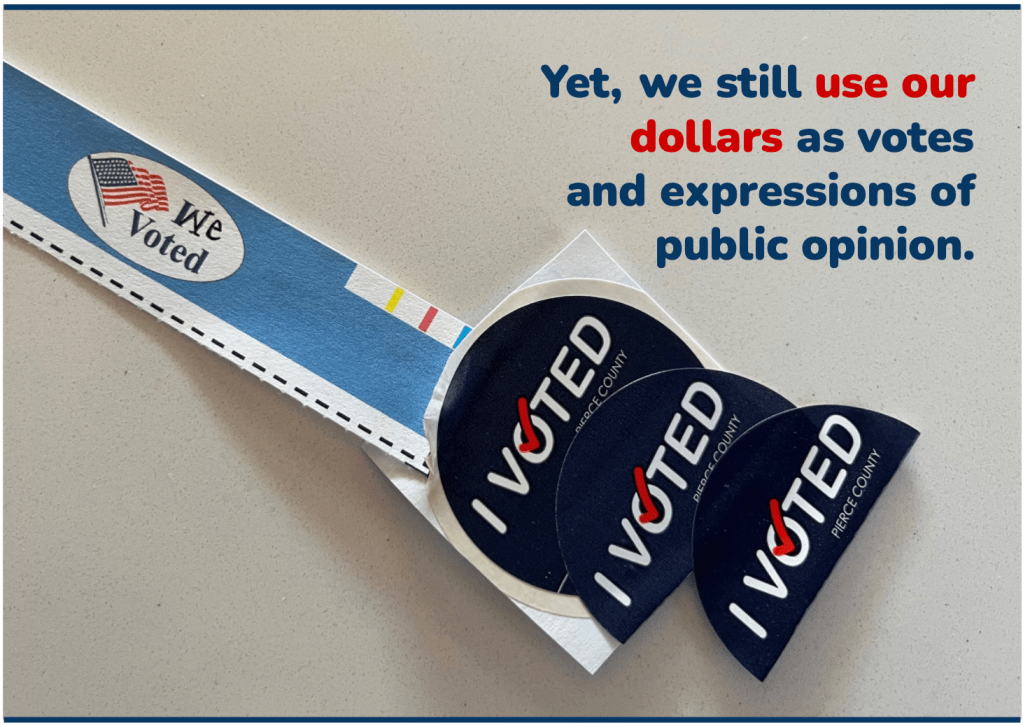
And in the last twenty years, we all would agree that consuming ethically has become even more confusing with information at our fingertips and corporate greed more prominent. Yet, we still use our dollars as votes and expressions of public opinion.
Fast forward to 2018, when some people boycotted Nike sportswear because the company had used Colin Kaepernick in an ad campaign; and to a 2024 radio news feature about fair trade cocoa, which provided listeners with a website listing ethical chocolate candy makers. If we care about kids in our schools, we ought to care about kids in forced labor in cocoa fields near the equator.
Finally, fast forward to January 19th, when I announced on Facebook that I would release Pigs and Flakes via Amazon, on March 1st. Would I have liked to have an agent and a publisher? Absolutely. This would have placed Pigs and Flakeson bookstore shelves and online. I had queried maybe six agents, listened to authors’ pros and cons of working with publishers, and weighed my options. As a lover of nature, I decided to self-publish through Amazon, despite this behemoth’s impact on indie bookstores. My decision was based on Amazon’s book-selling practices: their print-on-demand (POD) model, which prevents hundreds of books from sitting in a storage room, and the Kindle (electronic e-reader), which uses zero paper. Even though the Kindle uses electricity to recharge, we save resources by not having to keep a light on to read at night. These justifications are exactly why ethical consumption is so hard … so many choices and conundrums.
We all can name at least a dozen companies whose business practices we question whether they’re overusing precious natural resources, paying low wages, testing on animals, or breaking … some would call it bending laws.
To complicate things further, in late February, my stomach churned as I read Facebook posts encouraging people to boycott Amazon. Do I forge ahead with my plan or bow out to acknowledge this boycott? And will there be another controversary with a different company a few months down the road? No matter which decision I made, I would be choosing a side–placing Pigs and Flakes in the middle of an issue that wasn’t related to the themes of this story. I poured my heart and soul into creating a book with sustainable farming and love of the land as central themes, and publishing while conserving paper aligns closely with environmental preservation.
Out of respect for the boycott, I refrained from purchasing products from Amazon during the designated dates, March 7-14, and I did not post anything about my novel during that week. More broadly, I support small businesses as much as possible, buy clothes at consignment shops, recycle as much as recyclers will take from me and reuse baggies and containers, enjoy a latte in my personal cup, ride the bus to the airport, bundle errands to save on gas, and give experiences instead of tangible gifts. I plant and harvest fruit and vegetables and purchase produce from local farmers markets. As Scotty, in Star Trek, would say, “I’m giving her all she’s got, Captain.”
Maybe my deeply engrained Catholic guilt makes me hyper aware of my consumerism. Maybe my optimism for a better future for young people gives me the stamina needed to sustain commitments to conservation. Maybe my frustration with corporate and individual greed spurs me to push back.
I plan on releasing a second novel this winter and part of that plan is to explore other options for self-publishing. I haven’t yet reconciled how I can self-publish and support political ideals and bookstores. Might this even be possible?
I wonder how you all reconcile convictions and goals. I wonder if you have solutions to these conundrums.
To subscribe to these blogs, hover near the lower right corner, and click subscribe. The tool looks like this:


 Fedore Writer
Leave a reply to Sonya Shannon Cancel reply