
We’ve lost more people to this than we can count. Children, siblings, parents, grandparents, … ourselves. And it’s not just about losing our human connection, it’s about how brains are wired, how we perceive ourselves compared to others, and how we’re not motivated to leave our houses, or, worse yet, children aren’t motivated to leave their bedrooms because they’re glued to their devices.
Heading back to school represents a reset of norms and habits, especially for families with school-aged children. Family includes aunts, uncles, grandparents–all caregivers.
At the beginning of the school year, schools create a system for reviewing the student handbook filled with expectations for behavior. The goal is to maintain a positive, productive environment. Often these expectations are posted in classrooms and hallways as a gentle reminder.
What if families reset their own norms every fall? What if they posted their norms? No doubt, many families already do this.

Lisa Honold, founder of the Center for Online Safety, said this in a recent interview: “When it comes to screens and tech rules, your goal isn’t to shame or control your child. It’s to help them build healthy digital habits. That’s where a Family Tech Agreement comes in.”
What’s great about a family agreement is that it includes everyone, not just the children. My sister, Karen, is a retired registered nurse, and she explained that sometimes a mother and sick infant would visit the hospital, and it was determined that “failure to thrive” was caused by the parents being on their phones for too many hours instead of taking care of their newborn. This is an extreme example, but it illustrates how addictive social media and games are. A Family Tech Agreement would help some of us set our own limits and provide us with an incentive to resist the enticing pull of our devices.
As for children, I asked Lisa about age-appropriate guardrails. She said, “Age-appropriate guardrails are essential. Think of them as digital seatbelts, not to restrict your child’s freedom, but to protect them while they’re still learning how to ‘drive’ in the online world.”
Lisa’s research-based recommendations are:
- Ages 3–11: Max 1 hour per day of screen time, ideally co-viewed with a parent and focused on educational or creative content.
- Ages 12+: Limit to 2 hours per day of recreational or entertainment screen use. Schoolwork is separate. Begin introducing tech independence with close supervision. If your child needs a phone, make it a “dumb” phone or smartwatch.
- Smartphones at 14+: Set up the smartphone with free parental controls available at Apple Screen Time or Google Family Link and consider the paid app Bark, which gives you access to how your child is using their devices. Delay social media.
- Social media at 16+: This aligns with research and international trends. The EU, Australia and the UK have already passed legislation to raise the minimum age for social platforms to 16.
I remember hearing a radio interview and someone saying, “You wouldn’t drop off your child at the mall at ten o’clock at night and yet you give them access to an infinite internet world during that time.”
Lisa said it this way: “When we give kids unlimited access to dopamine-heavy devices, loaded with social comparison, content rabbit holes, and features designed to keep them scrolling, it’s like handing them the keys to a Ferrari car without a license.”
How do schools set guardrails?
Schools use interventions at intervals and often use a triangle to illustrate this.
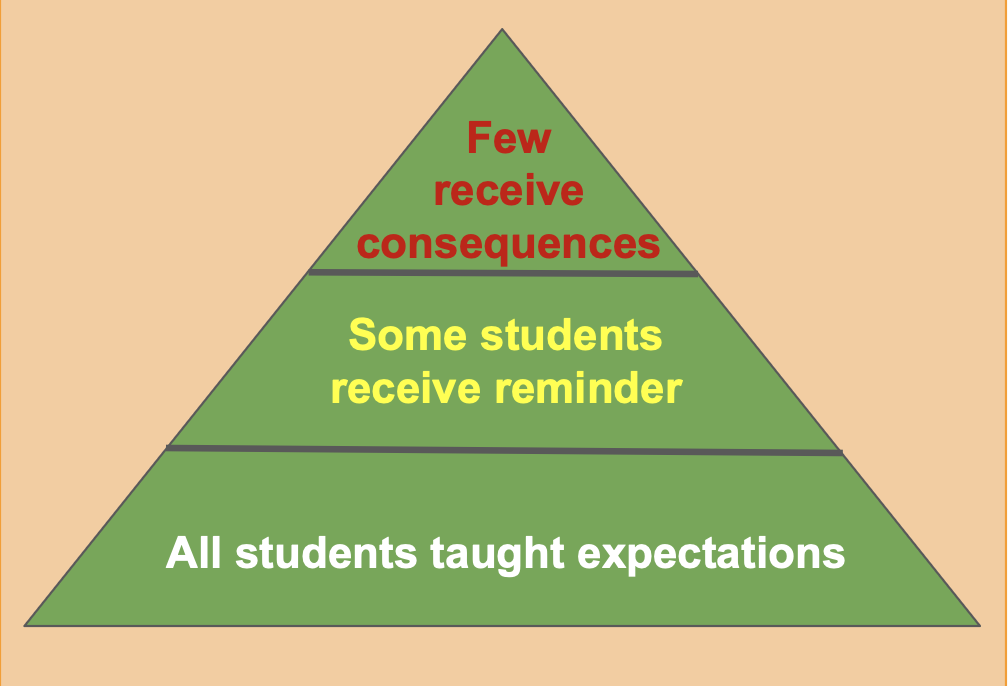
The bottom rung represents teaching guidelines to all students. (To be truly effective, staff members need to adhere to the guidelines as well.) For example, phones need to be put away during learning hours. The next rung represents a gentle reminder, such as a phone being taken away until the end of the day if the student uses the phone. The top rung might include a contract with a student who has used a phone multiple times, detention with a reflection activity, and/or a parent phone call.
“Breaking a tech rule isn’t a failure,” Lisa explained in our interview. “It’s an opportunity for a deeper conversation. What were they feeling? Why did they do it? What would they do differently next time?”
In schools, when a child’s phone is taken away, they often panic because they’re worried they’ll lose followers if they don’t respond. Picture a child clutching their phone as if it’s a lifeline–a dependence that isn’t healthy for a young person whose brain isn’t fully developed. When I witnessed a child panic like this it was not easy to stay strong and hold the boundaries. I hated being “the heavy” and creating conflict but it was necessary for the health of a child and a positive environment in the school.
Lisa said, “You’re not just raising a rule-follower. You’re raising a critical thinker who can make safe, intentional choices online, even when you’re not watching. And that’s the goal, right?”
How do caregivers put guardrails into practice?
“Your presence is your most powerful tool,” Lisa said, regarding preventive strategies. “Children and teens need to know that you’re involved, watching, and willing to talk.”
Lisa encourages parents to try this:
- Sit next to them while they scroll. Ask questions, be curious (not judgmental), and let them show you their favorite influencers, creators, or group chats.
- Create “tech together” time, like watching YouTube, playing a game, or scrolling TikTok side-by-side. This normalizes digital togetherness without making it feel like surveillance.
- Ask open-ended questions, like “What’s your favorite app? What do you like about it? What would you change if you could?”
Breaking habits is hard
Before Covid, our middle school was quite successful at creating a phone-free environment. We explained to students that we weren’t restricting their access for the sake of authority. Instead, we were committed to helping them wire their brains for future success. We explained that their brains are like a forest with pathways that get ingrained, and that we need to create multiple pathways with a variety of activities. We explained that their mental health and learning requires face-to-face social interactions. Most of the time, this explanation was all that was needed to encourage students to put away their phones and be in the moment. This dramatically changed when Covid seating restrictions were introduced, and students needed their phones to be able to interact with their peers during lunch and in the hallways, for example. When restrictions were lifted, it was challenging to get students off their phones again because dependence on their phones had become ingrained.
Telling kids why you’re setting limits is the best defense.
If your child, grandchild, or niece is pushing for more freedom on their devices or reluctant to break their habit, Lisa shared compelling reasons for curbing phone time:
- Teens who spend more than 3 hours a day on social media have double the risk of mental health struggles, including depression and anxiety (U.S. Surgeon General, 2023).
- 95% of teens have smartphones, and 46% of them say they’re on social media “almost constantly.” That’s not balance. That’s burnout.
Wholesale restrictions would likely create chaos and conflict, so start small with conversations. Lisa poses these questions:
- How is tech helping our family?
- How is it hurting our connection, sleep, mental health, or routines?
- What do we want more of (laughter, creativity, conversation)?
- What do we want less of (fights, isolation, late-night scrolling)?
After this discussion, you collectively figure out how you’re going to make these ideals happen. If you only change one thing, according to Lisa, get tech out of the bedroom at night.
“This is non-negotiable in our book,” Lisa said.
Phones, tablets, Chromebooks, gaming systems, smart TVs. They all need to charge somewhere else at night (we recommend a central charging station in the kitchen or living room).
Here’s why:
- Sleep is crucial for teen mental health. Late-night notifications, scrolling, and gaming sabotage that.
- Predators target kids late at night when they’re unsupervised and emotionally vulnerable.
- The temptation is real. Even well-intentioned teens struggle to resist notifications, messages, and streaks at midnight.
This one change can radically improve sleep, mood, and safety.
All aboard
I remember posing this question in a parent newsletter: What if every kid in our community wasn’t allowed to have their devices at night? No child would have FOMO (fear of missing out) and children would benefit from uninterrupted sleep. An entire community might not be ready to shift, but a group of parents could coordinate this. It starts with a conversation…
Creating change and shifting habits is as strong as our weakest link. Everyone needs to be on board. In a school, all staff need to model the tech expectations. If one teacher allows students to be on their phones, then it sabotages the limits other staff members are setting. If one parent or grandparent in a family is slack in monitoring or is on his or her phone during family time, the family agreement disintegrates.
Whole districts are enacting limits with phones at school and need parents and other adult family members to support these limits. So, please do not text students during the school day. Wait until after school hours or call the main office, if necessary. Having your child’s school set limits helps you with your efforts to limit phone time. Partnership and synchronicity are key.
Let’s hope broader change is on the horizon. In The Anxious Generation, Jonathan Haidt describes tech-company guardrails that are needed and Haidt promotes legislative change. Locally, let’s keep conversations alive. For example, our middle school showed films like Screenagers to educate parents and students, and we hosted a panel of experts.
In the meantime, people like Lisa Honold are available to give presentations, advising what to do. I welcome your comments below as well. In addition, here are a few resources:
When Should My Child Get a Phone? – A roadmap to digital safety, by age
Family Tech Agreement – Center for Online Safety – Download your own copy of the Family Tech Agreement to use at home
https://www.anxiousgeneration.com/parent-teacher-talk
https://www.awayfortheday.org – The “Away For The Day” initiative helps transform schools into cell phone-free spaces.


 Fedore Writer
Leave a reply to Mark D’Silva Cancel reply